Real-Time Fruit Detection & Counting on Mobile Edge Devices
Overview
Real-time fruit detection and counting using smartphone-based edge AI is crucial for numerous agricultural, retail, and nutritional applications. This report details our implementation of a compact yet powerful YOLOv8 model optimized for deployment on mobile edge devices.
Background and Motivation
Accurate fruit detection traditionally requires dedicated hardware, limiting accessibility and increasing costs. Leveraging smartphones as edge devices provides a scalable, cost-effective, and portable solution. This motivates our exploration of lightweight deep learning models and mobile optimization techniques.
Methodology
Hardware Specifications
We employed the Samsung Galaxy F41 smartphone. The specifications are listed below:
| Component | Specification |
|---|---|
| SoC | Exynos 9611 |
| CPU | 4×A73 @ 2.3 GHz + 4×A53 @ 1.7 GHz |
| GPU | Mali-G72 MP3 |
| RAM | 6 GB LPDDR4x |
| Storage | 128 GB UFS 2.1 |
| Display | 6.4” 2340×1080 Super AMOLED |
Software Tools
- Python 3.11, PyTorch, TensorFlow Lite, YOLOv8
- Android Studio (Java/Kotlin), Android NNAPI
- Google Colab (training), TensorFlow Lite Converter
Data Collection
Our dataset comprised:
- 2947 images with annotated fruit instances
- 182 test images
Images were collected from various viewpoints, lighting conditions, and backgrounds to ensure robustness. Annotations were generated using LabelImg.
Model Development and Compression
We adopted YOLOv8 for its efficient CSPDarknet backbone and PANet-based feature fusion.
Training and Fine-Tuning
We employed a two-phase training strategy:
Phase 1: Head-only Training
- Backbone frozen
- Detection head trained for 20 epochs
- Learning rate: 0.01
Phase 2: Full Fine-tuning
- Entire model unfrozen
- Trained for 30 epochs
- Learning rate: 0.001
Model Compression
- Original model size: 11.7 MB (float32)
- After INT8 quantization: 2.1 MB
- Outcome: Significant latency reduction with minimal accuracy loss
Model Deployment
The trained model was exported to TensorFlow Lite and integrated into an Android application. Real-time inference was achieved using CameraX and NNAPI delegates.
Inference Performance
- Achieved 30–45 FPS on the Galaxy F41
- Power consumption: Approximately 1 W
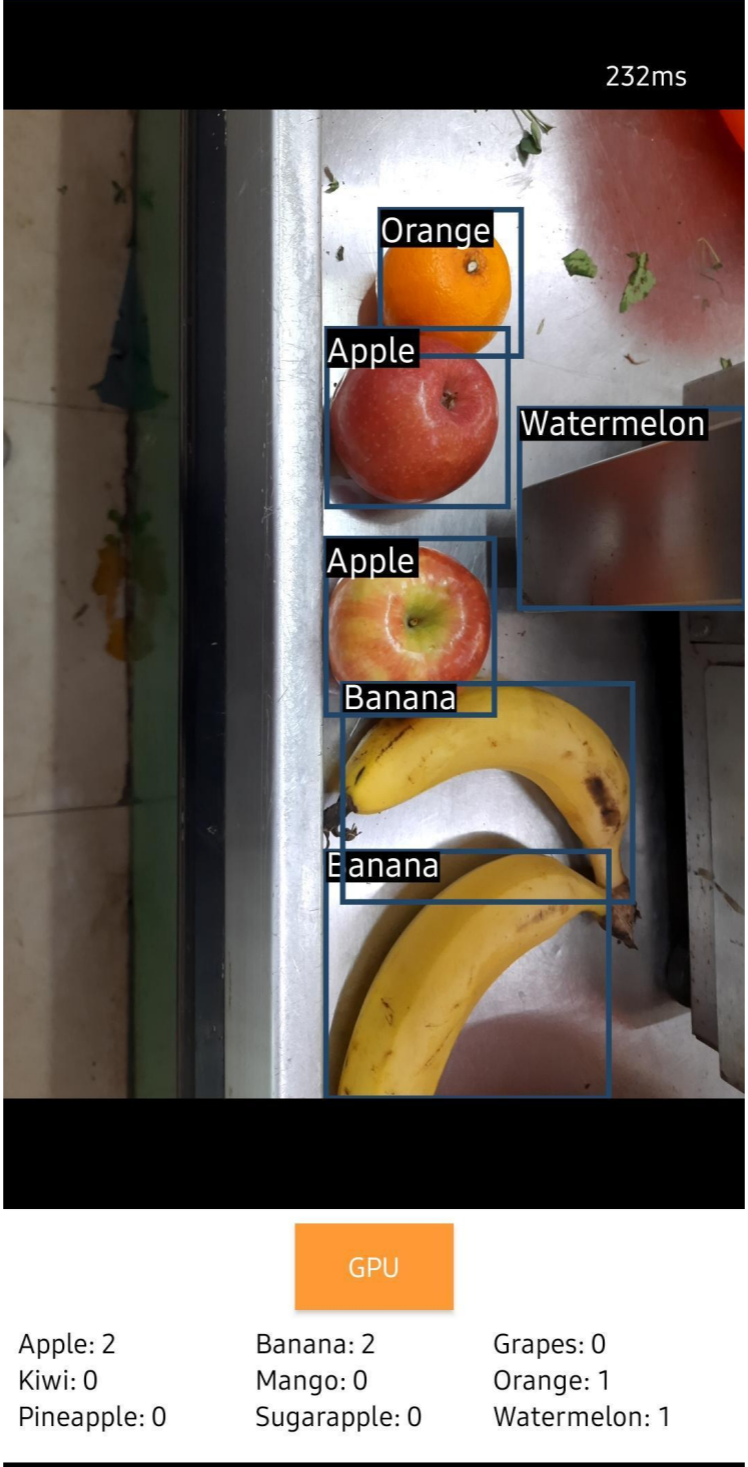
Prototype and Demonstration
The Android application features:
- Real-time camera feed with bounding box overlays
- Live counting of detected fruits by class
- Fully offline operation for privacy and responsiveness

Results and Performance
Performance Metrics
| Class | Precision | Recall | mAP@50 | mAP@50–95 |
|---|---|---|---|---|
| Apple | 1.000 | 1.000 | 0.995 | 0.936 |
| Banana | 0.738 | 0.477 | 0.581 | 0.361 |
| Grapes | 0.582 | 0.487 | 0.561 | 0.419 |
| Kiwi | 0.762 | 0.745 | 0.760 | 0.659 |
| Mango | 0.697 | 0.621 | 0.723 | 0.579 |
| Orange | 0.750 | 0.757 | 0.786 | 0.706 |
| Pineapple | 0.751 | 0.742 | 0.736 | 0.505 |
| Sugarapple | 0.653 | 0.833 | 0.815 | 0.599 |
| Watermelon | 0.785 | 0.698 | 0.743 | 0.564 |
| Average | 0.746 | 0.707 | 0.744 | 0.592 |
Challenges and Workarounds
Key Issues and Solutions
-
Limited Dataset Size
➤ Solved through data augmentation and transfer learning. -
Accuracy Drop from Quantization
➤ Mitigated with post-quantization fine-tuning. -
Mobile Inference Latency
➤ Resolved using NNAPI and GPU delegates for hardware acceleration.
Novelty and Conclusion
Main Contributions
- Real-time (30–45 FPS) fruit detection using YOLOv8 on mobile devices
- Lightweight two-phase training and compression pipeline
- End-to-end Android app with efficient on-device inference and live fruit counting
This work demonstrates a practical edge AI solution with applications in agriculture, retail, and nutrition. It shows how widely available smartphones can be leveraged for cost-effective, scalable AI deployments.