Anomly Detection in PV Panel
Objective
The goal of this project is to create an AI-based system that can identify irregularities in photovoltaic panels, which is essential for improving the efficiency of solar power generation, lowering maintenance costs, and guaranteeing long-term performance. In large-scale solar farms, where manual inspection is time-consuming and unfeasible. Hence, automated inspection systems are essential due to the growing worldwide push toward renewable energy sources, notably solar.
Types of Anomalies considered
- Clean
- Dust
- Organic Matter (bird droppings, leaves)
- Cracks
- Decolourisation
Hardware and Software Used
- PV Panels
- Nicla Vision
- OpenMV
- Edge Impulse
- Google Colab
Data Collected
- Image Resolution: 256 x 256 pixels
- Manually Collected Dataset: 2500 images
- Open-source Data: 500 images
- Data After Cleaning: 2000 images
- Data After Cleaning & Augmentation: 3000 images
Note: Open-source data was used to obtain clean datasets and drone shots of the panels to improve model robustness and generalizability.
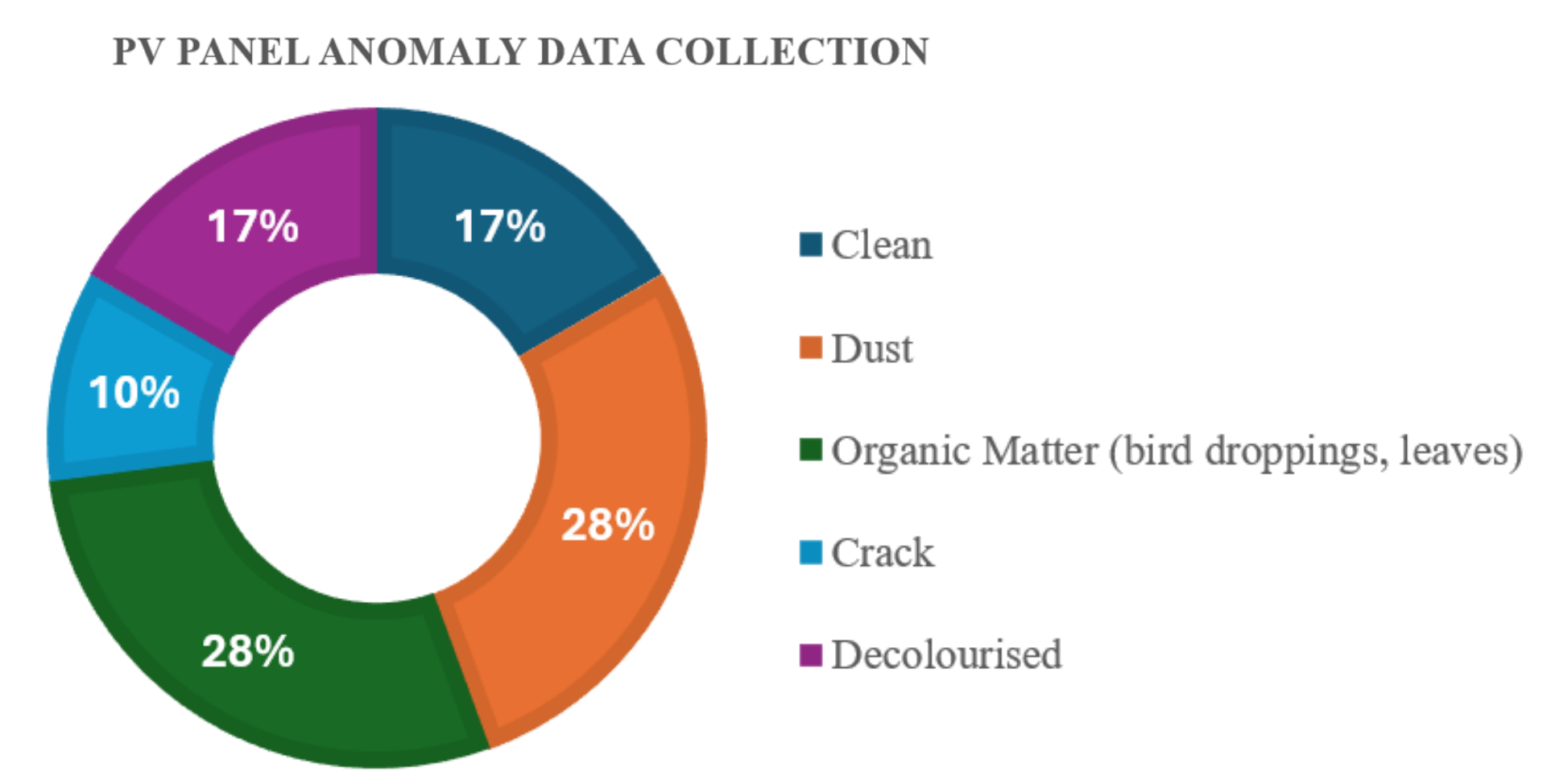
Anomaly Categories (Post Augmentation)
- Clean: 500
- Dust: 832
- Organic Matter (bird droppings, leaves): 855
- Crack: 312
- Decolourised: 500
Data Collection Process
- Tools Used: OpenMV and Nicla Vision
- Image Resolution: 224 x 224 pixels
- Time Frame: Morning and evening hours were selected to:
- Prevent glare issues
- Capture images under varied lighting and angles
Data Augmentation & Preprocessing Techniques
- Resizing to normalize input dimensions for model training
- Rotation and tilting to replicate changes in camera angle
- Cropping to highlight damaged or important areas
- Flipping and brightness variation to address illumination differences
- Horizontal and vertical shifting
Annotation Type
- Manual class labeling was performed using Edge Impulse, based on the type of anomaly observed in the image.
Challenges
During Data Collection
- Accessibility Issues: Some PV panels were located on rooftops or restricted-access areas
- Limited Time Frame: Data collection was restricted to early morning and late evening due to heat and glare
- Lighting & Perspective: Capturing consistent lighting and angles was difficult
- Multiple Anomalies: Some samples had more than one anomaly, complicating classification
- Crack Detection: Difficult to find visible cracks; many were too small to detect visually or using Nicla Vision
During Data Labelling & Model Training
- Annotating augmented images manually and ensuring consistent labeling was tedious
- Difficulty in selecting the optimal model for training
- Model Quantization: The biggest challenge was compressing the model to fit within space constraints while maintaining good accuracy
Results:
Best model performance:
- Accuracy: TinyCnn - 93% (on validation set) : MobileNet V2 0.35 - ~85% through Edge Impulse
-
Deployment model size: MobileNet V2 0.35 - ~40 KB (via Edge Impulse) : ResNet8 - ~50kB (quantized tflite model)
- Inference time: ~100 ms on Nicla Vision