Real Time Analog Meter Reader Using Edge Computing
Introduction
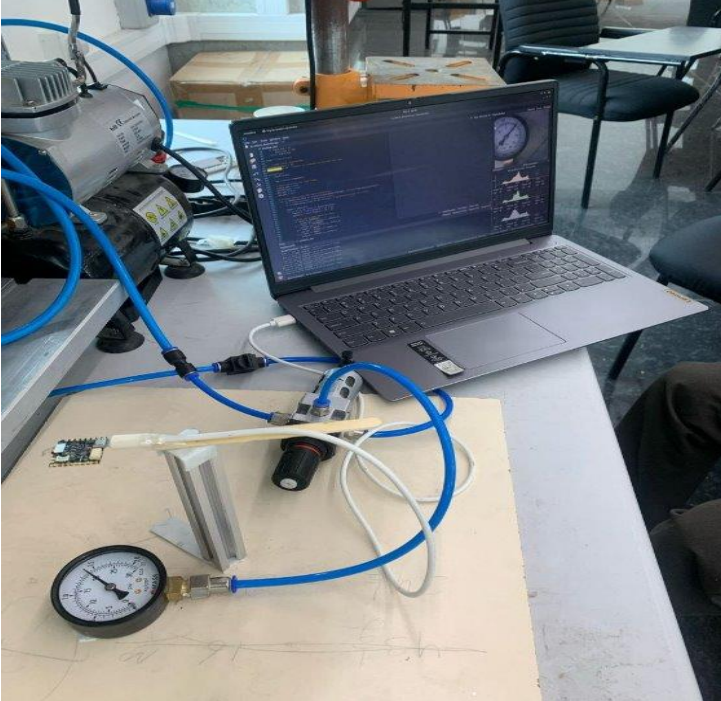
This project mainly focuses on developing a solution to read analog gauge meter readings using Arduino® Nicla Vision Camera. We first trained a deep learning model to detect the key components of the analog meter (meter, max, min, centre, and pointer). By calculating the angles between these components, the system can determine the actual reading on the meter. The model is deployed on Arduino® Nicla Vision, demonstrating real-time detection and recognition of analog meters.
Analog meters are still widely used by various industries to check measurements such as pressure, temperature, voltage, etc. Reading these meters manually is time-consuming and prone to errors, especially in automated environments. The motivation behind this project is to automate this process using a camera-based system, which can increase efficiency and accuracy in various industrial applications. We aim to offer a solution that can read and interpret analog meter readings accurately.
Methodology
Hardware and Software Required
- Arduino® Nicla Vision
- Analog Pressure Gauge
- Python
- OpenMV IDE 4.4.7 – for deploying and running inference scripts on Nicla Vision
- Google Colab – for experimenting with different models during exploration phase
- Edge Impulse Studio – for model training and optimization
- EONTM Compiler – for deploying the quantized model in a memory-efficient format
Data Collection
- Captured 2700 images from the pressure gauge under different camera and pointer positions.
- First dataset: 2000 images, with 100 images each for different pointer positions.
- Second dataset: 700 images captured using a fixed-height stand.
- Used a trained YOLOv5 model to annotate collected images.
- Trained using the “Analog Meter Dataset” [3].
- Annotations were manually verified and corrected as needed.
Model Development and Compression
- Trained a YOLOv5n model on a high-quality dataset from Roboflow, with annotations for pointer, center, and value markers.
- Fine-tuned for 50 epochs on a balanced dataset.
- Used this model to auto-annotate additional collected data.
Edge Device Challenges:
- Deployment on Arduino Nicla Vision (2MB Flash, 1MB RAM) was challenging.
- YOLOv5, even after quantization, was too large for the device.
- NanoDet was tested as a lighter alternative but had:
- Complex post-processing
- Manual tensor decoding issues
Final Solution: Edge Impulse’s FOMO
- FOMO (Faster Objects, More Objects) model selected due to:
- Efficient real-time performance
- Low memory footprint
Final Model Specs:
- Model: FOMO (MobileNetV2 0.35)
- Training Platform: Edge Impulse
- Quantization: INT8 post-training
- Deployment Tool: EON™ Compiler
- Final Model Size: 56.8 kB
Edge Impulse provided seamless integration and accurate performance, making it the final choice.
- Trained for 60 epochs with learning rate of 0.001 (on CPU)
- Dataset split: 80% training, 20% validation
- Used data augmentation during training
Model Deployment
- Final TFLite model deployed using OpenMV IDE scripts
- Runs fully on-device using onboard camera
- Detects pointer, max, min, and center positions in real-time
Custom Angle Detection Logic:
- Calculate angle between center-min and center-max lines → total angle
- For a given pointer position, calculate angle between center-min and center-pointer
- Ratio of pointer angle to total angle gives a percentage
- Multiply this ratio by (max reading - min reading) to get the actual meter reading
Challenges and Workarounds
- Model Size: YOLOv5n was too large, even in quantized form.
- Conversion Issues: TFLite version had unsupported ops and memory overflows.
- Explored NanoDet:
- Good speed & size
- Poor documentation
- Complex tensor parsing needed
- Thermal Issues:
- Nicla Vision experienced heating during continuous inference
Final Workaround:
- Migrated to FOMO from Edge Impulse
- Anchorless object detection
- Compatible with tinyML hardware
- Easy deployment with Edge Impulse tools
Additional exposure to TFLite, ONNX, and optimization for low-power MCUs gained during this process.
References
-
Object Detection using Nicla Vision
https://mlsysbook.ai/contents/labs/arduino/nicla_vision/object_detection/object_detection.html -
W. -J. Wang and P. D. Rosero-Montalvo
“A Gauge Meter Reader Edge Device Based on Computer Vision and Deep Learning”,
IEEE Embedded Systems Letters, doi: 10.1109/LES.2024.3507646 -
H. Sayed
“Analog meter Dataset”, Roboflow Universe, Mar. 2024.
https://universe.roboflow.com/hager-sayed-knqqb/analog-meter-dmoh4 -
L. Moreau
“Introducing EON Compiler RAM-optimized”, Edge Impulse Blog, Mar. 14, 2024.
https://www.edgeimpulse.com/blog/introducing-eon-compile