Smart Irrigation System for Precision Agriculture
Introduction
The Edge AI Precision Irrigation System is a fully autonomous, on-device solution for dynamically adjusting water supply to nursery-stage crops (e.g., onion seedlings) in response to environmental and crop conditions. It integrates historical climate data and real-time soil moisture sensing into a machine learning inference engine running on a microcontroller, which computes the crop’s current water demand and controls pump actuation without cloud reliance.
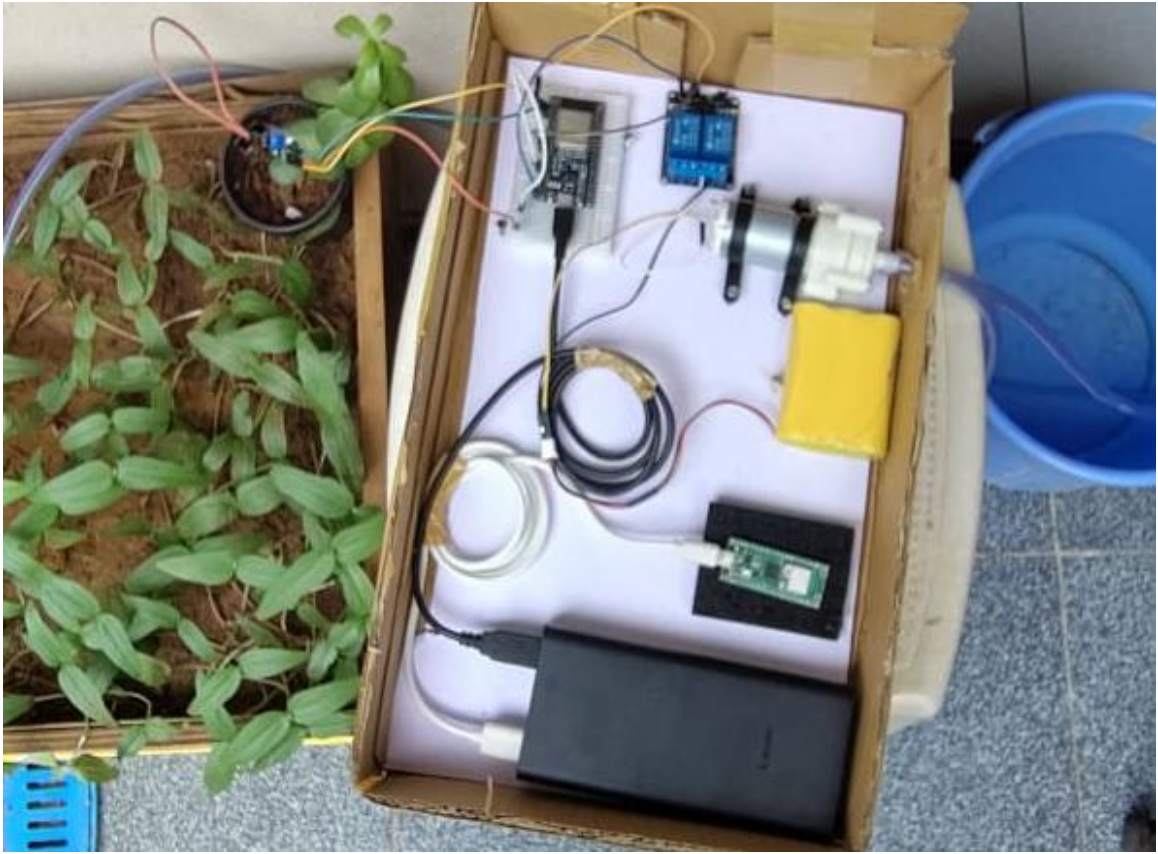
In our implementation:
- Weather inputs (Tmax, RH, Irradiation) via weather API feed an MLP-based model on a Raspberry Pi Pico W to estimate daily reference evapotranspiration (ET₀).
- ET₀ is then used to derive actual crop evapotranspiration (ET₀ × Kc).
- The computed water requirement is used by the Pico to set the irrigation volume.
- An ESP32 node drives a water pump via MQTT for the calculated duration.
Conventional irrigation often over-waters or follows rigid schedules, wasting water and harming crops. Onion seedlings are especially vulnerable:
- Early over-watering disrupts root aeration and yield.
- Uneven watering or waterlogging leads to soil salinity and nutrient loss.
In water-scarce regions, these issues are severe.
This system:
- Adjusts irrigation dynamically based on growth stage, weather, and soil moisture.
- Predicts reference ET₀ and applies the onion-specific Kc to deliver precise water per growth stage.
- Runs entirely on the edge, ensuring cloud independence.
Data Collection
Historical Climate Data
- Source: NASA POWER API
- Variables:
- Min & Max Temperature (
T2M_min,T2M_max) - Relative Humidity at 2m (
RH2m) - Wind Speed (
WS2m) - Solar Radiation (
ALLSKY_SFC_SW_DWN)
- Min & Max Temperature (
Label Generation (ET₀)
- Computed using the FAO-56 Penman–Monteith formula.
- These ET₀ values serve as labels for supervised model training.
Real-Time Sensor Data
- Analog soil moisture sensor installed per bed or pot.
- Outputs voltage proportional to volumetric water content (VWC).
- Converted to available water depth.
- Feeds the controller for real-time irrigation decisions.
Preprocessing & Feature Engineering
- Outlier Removal: Filtered extreme/erroneous values.
- Scaling: Applied Z-score normalization using
StandardScaler. - Feature Selection: Top 3 predictors identified via correlation analysis:
T2M_max(Max Temp)RH2m(Relative Humidity)ALLSKY_SFC_SW_DWN(Solar Radiation)
Model Design and Training
Model Selection
- Evaluated: Linear Regression, SVR, Random Forest
- Final model: Feedforward MLP Regressor
- Accuracy: ~97% variance explained
Architecture
- Two hidden layers: 16 and 8 neurons
- Activations: ReLU
- Optimizer: Adam
Training Configuration
- Dataset: ~5,569 samples (80% training / 20% testing)
- Early Stopping after 1500 iterations
- Performance:
- MSE ≈ 0.03
- R² ≈ 0.971
Methodology
ET₀ Prediction
- Pico gathers weather data via API:
Tmax,RH,Solar Radiation - Inputs fed to MLP model on-device
- Outputs ET₀ (mm/day)
Crop Water Demand (ETc)
- ET₀ × Kc (crop coefficient for growth stage) = ETc
- Represents daily crop water requirement
Soil Moisture Update
- Sensor feeds real-time VWC
- Converted to Available Water Depth
- Used to adjust or skip watering if soil is already wet
Irrigation Volume Calculation
- Rule-based logic or controller computes volume:
- If soil moisture < target → deliver
(ETc – depletion)
- If soil moisture < target → deliver
- Ensures optimal water delivery
Pump Actuation
- Pico sends MQTT command to ESP32
- ESP32 activates relay/pump for the required time
- Operates in a closed loop every 24 hours or on-demand
Hardware and Software Stack
Hardware Components
| Component | Specification | Role/Use |
|---|---|---|
| Raspberry Pi Pico W | RP2040 dual-core @ 133MHz, 264 KB RAM, Wi-Fi | Hosts MLP model, sensor reading, volume calculation |
| ESP32 | Dual-core 240MHz MCU with Wi-Fi/Bluetooth | Receives MQTT, actuates pump |
| Soil Moisture Sensor | Analog resistive sensor | Measures real-time VWC |
| Relay Module | 5V/12V controlled relay board | Switches pump power via GPIO |
| Water Pump | 12V DC pump (~X L/min flow rate) | Delivers water to crop |
Software Stack
| Tool | Use |
|---|---|
| Python (PC) | Model training, preprocessing: pandas, numpy, scikit-learn |
| MicroPython | Edge inference on Pico: matrix ops, manual activations |
| ESP32 FW | MQTT listener, GPIO toggle for pump relay |
| Support Tools | Thonny IDE, umqtt.simple, Jupyter for model export |
Results
ET₀ Prediction Accuracy
- R² ≈ 0.97
- MSE ≈ 0.10 mm²/day²
Model Efficiency
- Original model: ~18 KB
- Pruned for deployment: ~12 KB
- Inference time on Pico: ≤ 50 ms
- Fits within Pico W’s RAM/flash constraints
Challenges and Mitigations
1. Integrating Multiple Sensors
- Challenge: I/O and bandwidth limitations
- Mitigation: Multiple ESP32s; Wi-Fi aggregation
2. Sensor Accuracy Drift
- Challenge: Drift due to temperature or low-cost hardware
- Mitigation:
- Use temperature-compensated sensors
- Periodic recalibration
- Firmware-level smoothing (moving average)
3. Resource Constraints (Pico W)
- Challenge: Limited flash/RAM
- Mitigation:
- Prune and quantize model
- Manual implementation of inference logic
Conclusion
This project presents a complete Edge AI-based irrigation system for nursery crops:
- Leverages long-term climate data and on-device MLP for accurate ET₀ prediction
- Integrates soil feedback for optimal irrigation
- Achieves ~97% accuracy against FAO-56 benchmarks
- Fully cloud-independent and runs on low-cost hardware
- Successfully combines hardware and AI into a working prototype
Future Directions:
- Add user interface (LCD/app)
- Extend to more crop types via ensemble models
- Integrate additional environmental sensors
- Modular, open-source design supports replication and customization
References
-
Allen, R. G., et al. (1998): FAO-56 Penman–Monteith Method
Crop evapotranspiration: FAO Irrigation and Drainage Paper 56 -
NASA POWER API: NASA POWER Documentation
-
Pedregosa, F., et al. (2011): Scikit-learn: Machine Learning in Python
JMLR 12, 2825–2830 -
Onion Crop Coefficients (Kc): Allen et al., 1989
Agronomy Journal, 81(4), 650–662 -
MicroPython on Raspberry Pi Pico: Monk, S. (2019), The MagPi Magazine
-
ESP32 Datasheet: Espressif Systems (2021)
-
Irrigation Scheduling: Jones, H. G. (2004)
Journal of Experimental Botany, 55(407), 2427–2436 -
Wireless Sensor Networks: Akyildiz, I. F., et al. (2002)
Computer Networks, 38(4), 393–422 -
Project Repository:
AYRUS06 / Edge AI Based Precision Irrigation (GitHub)