Intelligent State of Charge (SoC) Estimation Using LSTM on Edge Devices
Introduction
The primary objective of this project is to develop an intelligent system capable of estimating the State of Charge (SoC) of Lithium-ion batteries using machine learning techniques, specifically Recurrent Neural Networks (RNN) and Long Short-Term Memory (LSTM) models. The system works with real-time data from two types of batteries:
- Li-ion NMC
- LiFePO₄
This addresses the shortcomings of traditional SoC estimation methods (e.g., Coulomb counting), which suffer from drift and inaccuracies.
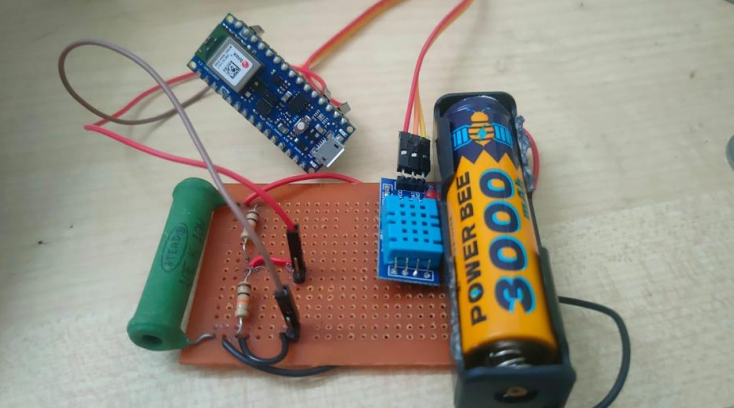
Data Acquisition Hardware
A custom hardware circuit was built using the Arduino Nano 33 BLE, connected to sensors measuring:
- Voltage
- Current
- Temperature
- Capacity
- WhAccu
- Previous SoC
- SoC from Coulomb counting
Data was collected during controlled charge/discharge cycles and used to train deep learning models.
Edge Deployment
After training, the best-performing model (LSTM) was:
- Quantized to float16
- Converted to TensorFlow Lite (.tflite)
- Compiled to C++ (.cc) for deployment
The final model was flashed onto the Arduino Nano 33 BLE, enabling real-time SoC predictions using just voltage, current, and temperature.
This project demonstrates a low-power, real-time, cloud-free Edge AI application for battery management systems.
Background and Motivation
Lithium-ion batteries are central to:
- Electric vehicles (EVs)
- Renewable energy storage
- Portable electronics
Challenge
A critical parameter in Battery Management Systems (BMS) is the State of Charge (SoC). Traditional SoC estimation methods include:
- Coulomb Counting: Prone to cumulative error
- Open-Circuit Voltage (OCV): Inaccurate under load
- Model-based methods: Require detailed electrochemical understanding
Motivation
With advances in AI and Edge Computing, more robust solutions are possible. RNNs and LSTMs are ideal for modeling time-series data like voltage, current, and temperature.
Our system is:
- Accurate and adaptive
- Based on simple measurements
- Deployed on embedded hardware (Arduino Nano 33 BLE)
It improves safety, reliability, and efficiency of battery-powered edge devices.
Methodology
Hardware Used
| Component | Description |
|---|---|
| Arduino Nano 33 BLE | Microcontroller with BLE and TensorFlow Lite support |
| Li-ion 18650 Cell | 3Ah rechargeable lithium-ion battery |
| LiFePO₄ Cell | Rechargeable lithium iron phosphate battery |
| 10W Power Resistor | For controlled battery discharge |
| 10kΩ Resistors | Used in voltage divider for voltage scaling |
| DHT11 Sensor | Measures ambient battery temperature |
Software Used
| Tool | Purpose |
|---|---|
| Google Colab (Python) | Model training and preprocessing |
| TensorFlow & Keras | Model architecture and training |
| TensorFlow Lite Converter | Conversion to .tflite format |
| Post-training Quantization | Float16 model compression |
| Arduino IDE | Code flashing and deployment |
| TFLite for Microcontrollers | Edge inference engine |
Data Collection Setup
- Voltage divider → Battery voltage
- Shunt resistor → Current (via Ohm’s Law)
- DHT11 → Battery surface temperature
- Sampling interval: 100 ms
- Total samples collected: 159,647
- Discharge until ~3.2V
Recorded Features:
- Voltage
- Current
- Temperature
- Capacity
- Energy (Wh)
- Coulomb-counted SoC (ground truth)
SoC Calculation Formula:
SOC(t) = SOC(t-1) - (Current × Δt) / Battery Capacity
Or simplified as:
SOC(present) = SOC(previous) + (Current / 10800 × 10)
Model Development
Model Architectures Explored:
- Recurrent Neural Network (RNN)
- Long Short-Term Memory (LSTM) Best performer
LSTM Model Architecture
- Two LSTM layers (128 units each)
- Dropout layers (0.2) after each LSTM
- Final Dense Layer: 1 unit, linear activation
Training Configuration
- Loss Function: Mean Squared Error (MSE)
- Optimizer: Adam
- Batch Size: 64
- Epochs: 15
- Early Stopping: Patience = 5 epochs
Results
- Training Loss: 2.26e-4
- Validation Loss: 3.88e-4
- Final Test Loss: 0.0025
Model Compression and Deployment
Conversion Pipeline:
- Keras → TensorFlow Lite (.tflite)
- Quantization to float16
- Converted to .cc (C array) using
xxd - Flashed to Arduino Nano 33 BLE
Edge Deployment
- Runs LSTM inference using voltage, current, and temperature
- Executes entirely on-device
- No need for cloud or external computation
- Output verified over serial interface
Real-Time Laptop Telemetry Validation
As an extension, we tested SoC estimation using laptop battery telemetry collected via HWiNFO64 over 2–4 hour sessions.
Collected Features (every 100ms):
- CPU / GPU / SSD temperatures
- Battery voltage, remaining capacity
- Power draw, wear level
- Estimated time, charge %
Processing & Modeling:
- Derived current & temperature proxy
- Smoothed, resampled, and scaled features
- Trained dense neural network with:
- Regularization
- Dropout
- Batch normalization
Evaluation:
- Compared model predictions vs Coulomb Counting
- Metrics:
- Mean Absolute Error (MAE)
- Root Mean Square Error (RMSE)
- Visualizations confirmed that neural network outperformed traditional method
Challenges and Workarounds
1. Data Collection
- Issues with resistor overheating and circuit failures
- Required multiple redesigns of:
- Voltage divider
- Current sensing section
- Maintained high-resolution sampling over long cycles
2. Model Deployment
- Original model too large for Nano BLE (float32)
- Applied float16 quantization
- Compatibility issues with TFLite model
- Required fine-tuning during
.cccompilation
3. Key Learnings
- Model size optimization is critical for Edge AI
- Hands-on experience in hardware-software integration
- Learned quantization trade-offs, memory management
- Valuable insight into deploying AI on microcontrollers
Conclusion
This project successfully demonstrates a complete pipeline for Edge AI-based State of Charge estimation:
- Trained LSTM model using real battery data
- Achieved high accuracy and generalization
- Compressed and deployed on Arduino Nano 33 BLE
- Validated on both physical batteries and laptop telemetry
It serves as a prototype for smart Battery Management Systems (BMS) and can be extended to:
- Predict battery cycle life
- Monitor health degradation
- Improve safety in IoT and EV applications